Date Uploaded: April 4, 2021
Permanent Link: http://wnhpc.com/details/fb1786418968186355
Contributor: Carol Van Etten on Facebook
Source: Facebook: Carol Van Etten
Source URL: https://www.facebook.com/groups/534602729921128/permalink/3787493084632060/
Source Caption: Not So Temporary Bill
Every seasonal resort depends heavily on employees who return annually to take up their old jobs for another year. This practice greatly benefits the resort’s continuity; patrons enjoy seeing a familiar face behind the front desk or in the dining room or picking up the trash, as it gives them a sense of belonging.
Some such employees are retirees, some have regular jobs that give them the summer off (such as teachers) and some are transients who move from place to place with the seasons, earning enough at one job to last until they can find another.
A man who seemed to belong to this latter group was Bill Warwick, who hitched a ride to Lake Tahoe with the Kehlet entourage back in 1920 and parlayed this lucky accident into four decades of summers in the Meeks Bay vicinity. Though it tends to start Bill out on the proverbial wrong foot, we’ll begin our account of him with a cameo provided by Pearl Kehlet, second wife of George Kehlet and much involved in the financial business of Meeks Bay Resort. Pearl’s comments are from a privately printed memoir of the Resort that she wrote in the late 1970s, courtesy of Jean Kehlet Rosso.
“There were some unique and very individual men who attached themselves to Meeks Bay and the Kehlets. Bill Warwick, nicknamed Temporary Bill, was picked up along the highway as the caravan went to the Lake that first spring. From Australia originally, he was tough and hard and arrived every spring.
One year he helped install the pipe for the water system in the subdivision; when he came to a rock that was too large to move, he “temporarily” bent the pipe around it. His temporary installations were the cause of many problems later as he never went back to make them permanent.
He was a good storyteller, like the one about the footrace he entered in Australia. He actually crossed the finish line rather far back, but got first prize because his legs went faster than the others.
He was a problem for Oswald, always proposing new ideas that would not work. In the end he came out ahead and this did not often happen when dealing with Oswald. Bill persuaded Oswald to let him build what he called “The Tower” on a piece of land in the subdivision. The building itself was an eyesore and the operation a failure.
Oswald as well as the neighbors from the Rubicon area were anxious to be rid of the eyesore, but Bill drove a hard bargain. He received clear title to two lakefront lots and part interest in another. The next spring “The Tower” was down and the usable lumber eventually became part of George’s house on the point.”
In Warwick’s defense, he was an innovator who pursued his dreams with great passion, while Pearl was a number cruncher who pursued the bottom line. It was Warwick’s ingenuity and hard work that allowed Oswald Kehlet to keep his promise to provide piped water to the growing number of property owners in Meeks Bay Vista. Boomers who spent their early summers in the subdivision can still remember sections of this pipe visible along the yet-to-be-paved Kehlet Drive. (Unburied water supply lines were the rule in early Tahoe subdivisions, and most were shut down and drained each fall to avoid pipe-busting freeze-ups and not reactivated until the following Memorial Day weekend.)
When not otherwise occupied with the business of the Resort, Bill built an unknown number of piers for lakefront homeowners in Meeks Bay Vista, including the one pictured for Dr. J.E. Fairbanks in South Tract.
Incredibly, Bill drove all the pilings for his piers by hand, using only a sledgehammer and a hand saw! This is all the more remarkable in light of the fact that Bill was not a large man. His World War II Draft Card gives his height as 5’7” and his weight as 180 pounds – undoubtedly still all muscle in his sixth decade of life.
As Warwick labored at his various projects, his fertile mind continued to churn out ideas, the next being a multi-purpose venue that he called The Tower.
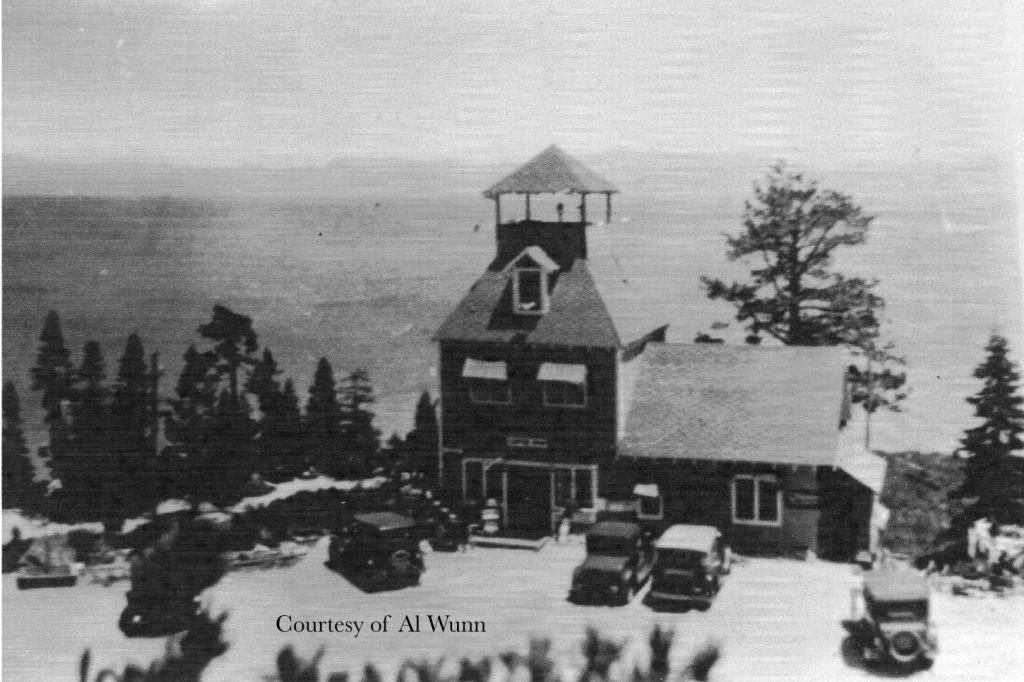
Few business people were embarking on new ventures in the midst of the Great Depression, but Warwick was eager to try his latest idea, and in 1933 he convinced Oswald Kehlet to allow him to build a three-story structure on two unsold highway lots in the Vista. The building, which stood in the wide turnout next to the main entrance to the Vista, included a fountain and sandwich shop below, topped off with an open-air cupola equipped with adjustable lenses for observing the natural marvels of the Lake.
As it turned out, Warwick’s venture into culinary entrepreneurship lasted but a single season. The Tower was doubtless the best roadside view of the Lake between Emerald Bay and Eagle Rock, but in the days before the Tahoe skyline became riddled with the contributions of man, many considered its presence a blight, and when the business ended its inaugural season in the red, Kehlet declared the arrangement null and void. His grandson Fred recalled the cold spring of 1934 when he and long-time MBR employee Phil Geier were given the job of dismantling the short-lived attraction.
The setback of losing The Tower did little to dampen the enthusiasm of the redoubtable Bill Warwick, who proceeded to build himself a home on one of the Meeks Bay Vista lots he had acquired from Kehlet. He enjoyed boating, and in later years worked for Dave Chambers of Chambers Lodge, piloting that resort’s Gar Wood, CAPTAIN KIDD (the former RAN-JAC II, originally owned by Tahoe Yacht Club Commodore R.C. Walker) on speedboat rides for hire.
It was only when I thought I knew all about Bill Warwick that I decided to venture into Ancestry.com to learn what hard, dry facts I could, and there a few clicks revealed that the story of his life as understood by most of the Tahoe folks who knew him was quite unlike the truth. I have since checked and rechecked my discoveries and can now dispel a few of the enduring myths.
First, Bill was not an Aussie after all, but had been born William Wallace Warwick on July 29, 1890 in Gloucester, England and had come to America about 1910, settling in San Francisco. I offer his World War I Draft Card in testament to these origins:
Another misconception perpetuated by Pearl Kehlet’s account (or perhaps it was only an oversight) was the absence of a partner in Warwick’s life. Quite to the contrary, in 1912 Warwick married Ethel Smith, three years his junior and also a native of England. Prior to the 1920 census the couple had added a daughter and a son to their household, which also included Bill’s parents, William and Josephine Warwick (Warwich).
Among Bill’s first jobs on his arrival in San Francisco was elevator operator, and while thus employed he mastered the skills of an electrician (probably between passengers on the elevator), a trade he would pursue through much of his life. (He was still listed as an electrician in the 1943 San Francisco City Directory.)
By 1915 the Warwicks had purchased a house in the 2400 block of Cabrillo Avenue in San Francisco, (current SF realtor info says the house was built in 1914 – presumably for the Warwicks) and for the next three decades Bill apparently pursued a conventional job in the trades during the winter months. However, his first taste of Meeks Bay in 1920 had convinced him (like so many others before and since) that summers should be spent at the Lake, and so the arrival of spring signaled time for the Warwick family to head for Tahoe.
Ethel passed away in San Francisco in 1946, and though discoverable details of Bill’s next decade are few, we know that he followed her to her rewards in January 1960, six months shy of his 70th birthday. And while there is no arguing William Wallace Warwick’s status as a legendary character in the annals of Meeks Bay history, the true details of his life are perhaps even more fascinating than the legend.
Download Photo: JPG (493 KB)